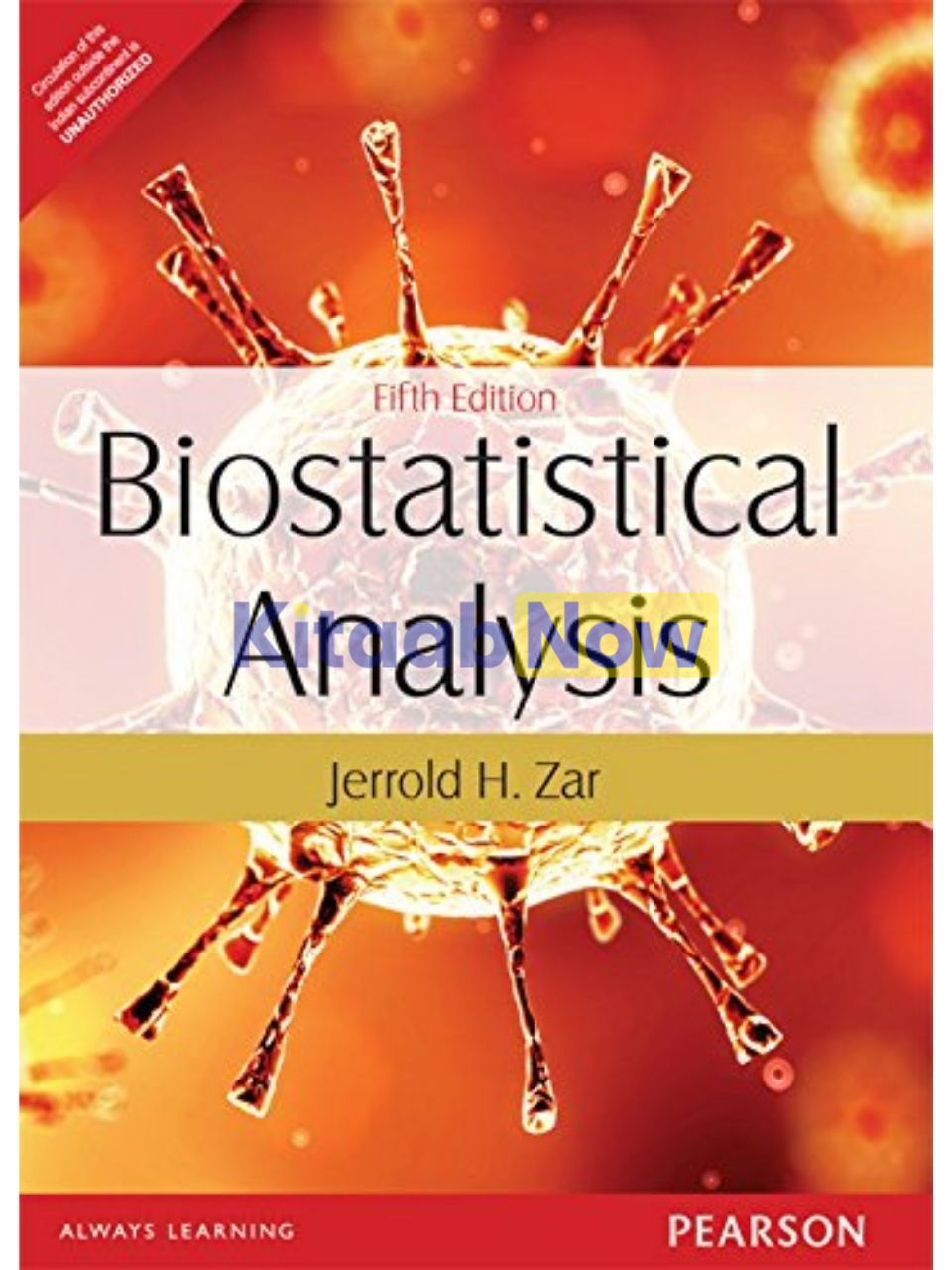
Biostatistical Analysis (5th Edition)
$ 13.92
Retail prices excluding local 15% VATSecure Checkout and Payment Options
Fast, Reliable Delivery
In the detail
- V266ml – H92mm
- 100% glass
- Highly chip resistant
- Dishwasher and glasswasher safe
- Duratuff reinforcement
- Suitable for the service of coffee as well as spirits on the rocks
- Available in a range of sizes, perfect for any occasion
Have any queries?
Learn more about the brand

DescriptionZar’s Biostatistical Analysis, Fifth Edition, is the ideal textbook for graduate and undergraduate students seeking practical coverage of statistical analysis methods used by researchers to collect, summarize, analyze and draw conclusions from biological research. The latest edition of this best-selling textbook is both comprehensive and easy to read. It is suitable as an introduction for beginning students and as a comprehensive reference book for biological researchers and for advanced students.This book is appropriate for a one- or two-semester, junior or graduate-level course in biostatistics, biometry, quantitative biology, or statistics, and assumes a prerequisite of algebra.Key FeaturesA broad collection of data-analysis procedures and techniques are presented, covering a wide variety of biological research, such as physiology, genetics, ecology, behavior, morphology.The most comprehensive treatment available includes coverage of the basics of statistical analysis, and also the following topics rarely or never found in statistics books for biologists:DiversityPolynomial regressionMultidimensional contingency tablesStepwise regressionNonparametric multiple comparisonsHigher order factorial analyses of varianceCircular distributionsPower and sample size determinations.An orderly organization and presentation of topics, with cross-referencing as appropriate.The readable and accessible approach allows students with no previous statistical background or mathematical expertise beyond simple algebra to understand the material presented.The thoughtful presentation encourages students to think about the value of each statistical technique, as opposed to merely plugging numbers into formulae.The exposition considers complex procedures such as factorial analysis of variance and multiple regression in terms of the interpretation of typical computer output.A wealth of graphs and other figures are integrated to visually support concepts under discussion.A uniquely comprehensive set of statistical tables-more than 40 in all-facilitates statistical analyses without having to consult a separate book. This includes tables that are unique to this book.Worked examples for all major procedures guide readers step-by-step through the techniques, demonstrating each of the important concepts.An extensive bibliography directs readers to further relevant literature.New to this EditionThis edition includes revised, updated, or enhanced coverage of the following topics.Normal distributionTesting for normalityPower in statistical hypothesis testingThe underlying assumptions, and their violation, in parametric and nonparametric testingA new introduction of prediction limits and one-tailed confidence limitsAnalysis of varianceComparing variancesMultiple-comparison testing, emphasizing the most highly regarded proceduresRandomized-block, repeated-measures, and multivariate analysis of varianceSimple and multiple linear regression and correlationKolmogorov-Smirnov goodness-for-fit testing for ordinal data, both two-tailed and one-tailed, continuous and discreteContingency-table analysis by chi-square and the Fisher Exact TestThe use of binomial distributionTable of ContentsData: Types and PresentationsPopulations and SamplesMeasures of Central TendencyMeasures of Variability and DispersionProbabilitiesThe Normal DistributionOne-Sample HypothesesTwo-Sample HypothesesPaired-Sample HypothesesMultisample Hypotheses and the Analysis of VarianceMultiple ComparisonsTwo-Factor Analysis of VarianceData TransformationsMultiway Factorial Analysis of VarianceNested (Hierarchical) Analysis of VarianceMultivariate Analysis of VarianceSimple Linear RegressionComparing Simple Linear Regression EquationsSimple Linear CorrelationMultiple Regression and CorrelationPolynomial RegressionTesting for Goodness of FitContingency TablesDichotomous VariablesTesting for RandomnessCircular Distributions: Descriptive StatisticsCircular Distributions: Hypothesis TestingAppendix A: The Greek AlphabetAppendix B: Statistical Tables and GraphsAppendix C: The Effects of Coding DataAppendix B: Analysis of Variance Hypothesis TestingAnswers to ExercisesLiterature CitedAuthor IndexSubject IndexAuthor BiographyJerrold H. Zar received his undergraduate degree in Biological Sciences from Northern Illinois University in 1962. He later earned his M.S. and Ph.D. degrees in biology and zoology from the University of Illinois at Urbana-Champaign. Zar then returned to Northern Illinois University for 34 years to serve in a variety of capacities. He joined the faculty at NIU as an Assistant Professor in 1968 and quickly rose through the ranks of associate and full professor to become Chair of the Department of Biological Sciences in 1978. He served two terms as Chair of the Department and then, became the Vice Provost for Graduate Studies and Research and Dean of the Graduate School. He was a founder of the Illinois Minority Graduate Incentive Program and the Illinois Consortium for Educational Opportunities Program, where he helped create and protect fellowship opportunities for minority graduate students at universities across the state. Zar is a member of 17 professional scientific societies, including being an elected fellow of the American Association for the Advancement of Science. His many research publications cover a range of topics, from statistical analysis to physiological adaptations of animals to their environment.